
Lenten Reflection
*Sermon shared at Hesston Mennonite Church, Kansas
Introduction
Dear brothers and sisters, receive warm greetings and a fraternal embrace from the SEMILLA, The Latin American Anabaptist Seminary, in Guatemala, and from our entire network in Latin America and the Caribbean.
I understand that many of you have been following the theme of Dwelling in Dissonance during Lent. For the fifth week, the study takes us to the trial of Jesus by Pilate in the book of John. This is a moment in the Passion that we often observe from the distance of history, but which beats with terrifying urgency in our present: the moment when power decides to wash its hands.
We all know the gesture of Pontius Pilate washing his hands, described openly in Matthew’s Gospel and implicitly present in all four Gospels. This symbolic act reflects his attempt to detach himself from responsibility for the crucifixion, though it does not absolve him of moral complicity and responsibility. In John 19, it is reflected in the gesture of one who has the privilege of choosing neutrality. Before him stands Jesus: a tortured body, a man from the margins, someone who does not have the luxury of being “indifferent” because his very life is at stake. We may sometimes have read this passage as a private spiritual drama, but today I invite you to see it through the eyes of my brothers and sisters in Cuba, Nicaragua, Mexico, Colombia, and in all the borders and places of conflict and oppression.
In Latin America, we have learned that indifference is not a void; it is a decision. When Pilate washes his hands, he does not become neutral; he simply allows injustice to continue. Today, I do not come only to bring you news, but to ask: What do we do with our hands while the “empire” of individualism and hatred besieges the lives of the smallest ones?
At SEMILLA, we believe that theological education is not about reading the bible as theological concepts to be discussed and debated from a distance. Rather, we teach about reading, deepening, and embodying it so that our hands do not seek the water of indifference, but instead learn to carry the cross of peaceful and active resistance.
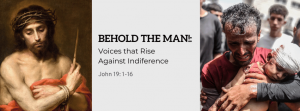
Today, the Gospel places us in Pilate’s courtyard. There stands Jesus, disfigured by torture, yet embodying a dignity the empire cannot comprehend. When Pilate presents him to the crowd, saying, “Behold the man!”, he intends to mock his fragility. But in reality, he is pointing to the only truly free person in that space. For in this broken man is revealed innocence betrayed by fear, justice stifled by indifference, and mercy resisting empire with the certainty of being upheld by truth.
In this Lenten season, this passage is not only a historical account; it is a mirror confronting us with our own response to power and injustice. Are we disciples who walk with the Crucified, or spectators who, like Pilate, seek a disingenuous neutrality?
The Importance of Not Being Indifferent
Jesus stands with the oppressed. He is beaten like the poor, mocked like the marginalized, condemned like the innocent victims of injustice. His trial unmasks the arrogance of power. Yet those victims of violence, discrimination, hate crimes, and racism are not only victims of their aggressors and their misuse of power. They are also victims of our indifference, of our lack of compassion, of our lack of action. When we say—even only to ourselves—“It’s not my problem, it doesn’t affect me, it is not happening here” we betray the compassion Christ teaches us on the way of the cross.
Indifference is an acid that corrodes our humanity and our holiness. Discipleship calls us to face injustice directly and not remain silent.
Recognizing Our Power
Pilate held power in his hands. He knew Jesus was innocent, but he chose to wash his hands. We too have power: the power of influence, the power of decision, the power to raise our voices.
Brothers and Sisters, we cannot deny that power. We cannot deny our influence or our role in the actions and decisions our leaders take in our name. Certainly, we can use that power to protect ourselves and remain silent, or we can use it to lift others up, to be their voice, to proclaim God’s justice and peace.
The Handwashing: The Myth of Political Neutrality
Pilate personifies “neutrality.” He knew Jesus was innocent, but chose to wash his hands to protect his position. Friends, in the Global North, the temptation is to believe that our passivity has no consequences. But washing our hands of the injustice that strikes our neighbors in the South is, in reality, a political decision in favor of the oppressor.
When arms are sold, and military advice is given to oppressors, we wash our hands if we do not raise our voice.
When we purchase goods from companies that exploit developing countries, drain their resources, pocket enormous profits, and refuse to pay fair wages or offer decent jobs, we wash our hands bearing full responsibility if we fail to demand justice.
Indifference is not a void; it is a cancer that allows violence, racism, hate, and exclusion to continue crucifying the innocent. The Gospel demands that we stop being indifferent, that we not wash our hands, but rather soil them in the construction of Shalom.
How to Live the Kingdom and God’s Shalom
In this passage, Jesus gives us an example of how the Kingdom is lived. I would name it peaceful resistance. His silence was not passive or permissive. It was forceful. The silence of Jesus is not a lack of words, but a refusal to engage the language of the Empire. While Pilate shouts and the crowd demands blood, Jesus remains in a silence that speaks of the certainty that truth is on his side. As Anabaptists, we sometimes confuse peace with complicit silence. But the silence of Jesus before Pilate is that of one who refuses to be complicit or intimidated.
Jesus is not a voiceless victim; he is a witness to the Truth that unsettles the status quo. His silence says: “Your system of death has no power over my identity.” Discipleship calls us to this kind of courage: not to remain silent out of fear, but to inhabit a silence that judges the arrogance of power.
How many times has our silence not been that of Jesus, but that of complicity?
How many more will be tortured or killed before the church raises its voice?
SEMILLA: Cultivating Upstanders in the Garden of Resistance
Here’s where theological education truly comes alive. At SEMILLA, our goal isn’t to simply “know more,” but to better “follow Jesus” in places of suffering. A living example of this is a Nicaraguan student, whom I’ll call Rosa Esteban, to protect her identity.
Since 2018, Nicaragua has faced a deepening human rights crisis marked by authoritarian governance, suppression of dissent, and widespread persecution. Critics face exile, loss of citizenship, and confiscation of assets. Hundreds of NGOs, universities, and independent media outlets have been shut down. The government targets anyone outside its control, including human rights defenders and religious leaders, many of whom have been expelled, barred from returning, or arbitrarily detained and imprisoned.
Amid this unrest, Rosa dares to interpret Scripture through the lens of Jesus’ compassion. She writes letters to Rosario Murillo, the Co-President of Nicaragua, widely feared and condemned for her role in human rights violations. Rosa chose a different path. In the letters she sends to Murillo, she talks about love, peace, and Shalom. She prays for Murillo and her family and personally delivers these letters to the presidential office, risking her own safety because she believes that even the hardest heart can be touched by Christ’s mercy.
Rosa said: “The message of forgiveness that Jesus gives us is for her too. It is possible to adopt a different approach to being a disciple of Jesus. A different theology is possible, and so is being a different church, living another way where fears, myths, and anxieties have been broken. Now I feel more compassion for people whom I believed did not deserve to be forgiven.”
Rosa is answering the call to be an upstander, not a bystander, in order to transform her community and to confront violent structures as an agent of reconciliation. She has heard the call to see each person as someone with potential for change, growth, and love.
Living in the Kingdom means seeing not only neighbours and foreigners, but also enemies through the eyes of grace. It means believing that transformation is possible — not only in our communities but also in the corridors of power.
Discipleship requires courage. It calls us to be upstanders—people who rise and act—not mere spectators. It calls us to sow peace where others sow fear and violence.
Application For Us Today
In North America, in Guatemala, in Nicaragua, the temptation is the same: to remain silent, to avoid risks, to let injustice pass unchallenged. But the Gospel calls us to something else. It calls us to recognize our power and use it for good. It calls us to resist peacefully, with courage, with love, with mercy.
The question from John 19 remains: Will we cry out with the crowd, “We have no king but Caesar”—the Caesar of our comfort under the powers that be? Will we wash our hands while others suffer the cross of injustice? Will we turn our faces away while others suffer? Or will we stand with Jesus, declaring with our lives that He is Lord, and that His way of mercy is stronger than violence, and his way of peace the way of a better kingdom?
Conclusion
Jesus walks with us in this Lenten season. The path to redemption is arduous, marked by pain and challenge, but also full of hope. We not only wait for a future resurrection, but seek to experience resurrection here and now: a new and abundant life, a church that fulfills its mission by raising its voice against injustice and sowing seeds of peace amid fear.
Discipleship calls us not to wash our hands like Pilate, but to use them to heal, to defend, and to proclaim the Kingdom of God in our present history.
¡He aquí el Hombre!, Behold the Man! resonates with the Lenten theme of dwelling in dissonance, because it places us right at the tension between two irreconcilable realities: the power of empire embodied in Pilate, and the power of the Kingdom embodied in Jesus. To dwell in dissonance is to resist the temptation of easy answers; it is to inhabit the uncomfortable space where neutrality is exposed as complicity, and where silence can either be cowardly indifference or prophetic resistance. Discipleship is lived in that dissonance: acknowledging our privilege and power, confronting the temptation to wash our hands, and choosing instead to act with mercy and justice. The testimony of Rosa Esteban embodies this call—she lives in the dissonance of oppression and hope, fear and courage, yet chooses to sow seeds of peace. In this way, the Spirit calls the church in North America, in Latin America, and beyond to remain in that unsettling space, to let discomfort sharpen our awareness, and to transform dissonance into faithful resistance and solidarity.
Final Prayer
Lord Jesus, you were beaten, mocked, and condemned like the innocents of our time. Forgive us when we have been indifferent, when we have sought the safety of neutrality and remained silent in the face of injustice. Grant us the courage of your dignified silence and the strength of your prophetic word. Make us a church that does not wash its hands, but extends them to lift up the fallen, to sow mercy, and to proclaim your justice. May this Lenten season teach us to walk with you toward the cross, with the hope of resurrection that blossoms in every act of solidarity. Amen.